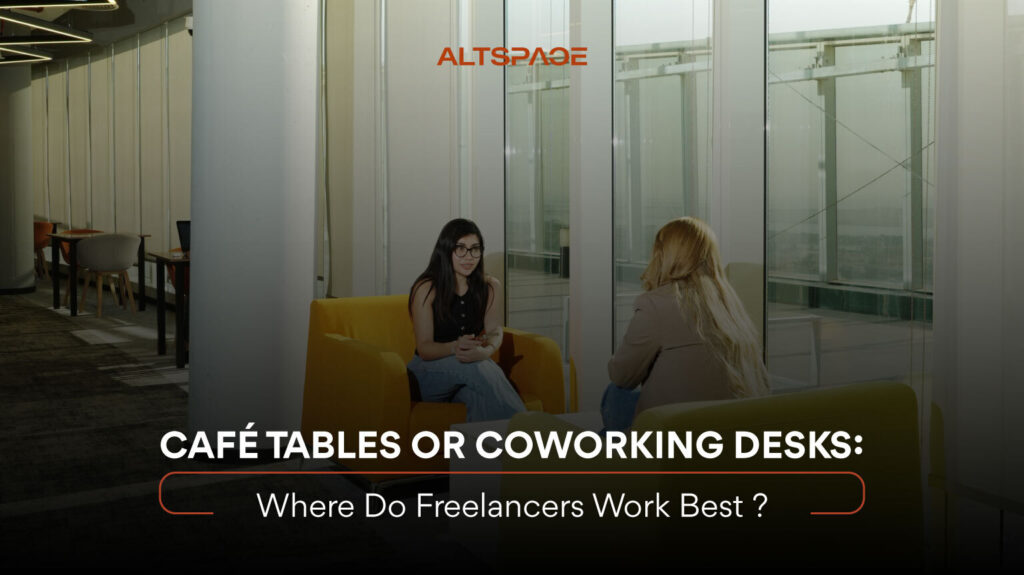
I learned to recognize my own work rhythms by where my laptop landed. Some weeks it was a café table, always the same one near the window, the chair slightly unstable. Other weeks it was a shared desk in a coworking space, neutral light, neutral sounds, neutral faces. Neither felt permanent. Both felt necessary at different moments.
Freelancers talk a lot about flexibility, but less about friction. Every place you work introduces its own small resistances. The question is rarely where work is best, it’s where work is bearable for the next few hours, and sometimes for the whole day.
The café as a working environment, not a lifestyle
Cafés are not designed for work, which is precisely why many freelancers end up there. There is no expectation of performance. No one cares how long you stare at the same paragraph. The background noise is constant but not demanding. Cups clink, conversations rise and fall, music plays badly mixed through old speakers.
By late morning, cafés fill with a particular mix. Students pretending not to procrastinate. Freelancers pretending they are not working. People who clearly came only for coffee but stay because it feels easier than going somewhere else.
The appeal isn’t productivity. It’s permission.
You can leave at any moment without explanation. You can sit for forty minutes or four hours and no one marks your presence. The environment absorbs your pauses. Staring out the window feels acceptable. So does scrolling, for a while.
Many freelancers don’t choose a workspace for productivity alone. They choose it for how it feels at 3 p.m., when energy dips and the day starts to stretch.
What cafés quietly give, and quietly take away
There are things cafés offer that no coworking desk can replicate. Not better, just different.
- A sense of anonymity without isolation
- Movement and change without planning
- Sound that distracts just enough to dull overthinking
At the same time, cafés extract their cost slowly. Power outlets are never where you want them. Chairs were not meant for six-hour stretches. You become aware of how long you’ve been there. You calculate whether ordering another coffee feels polite or excessive.
There’s also the unspoken negotiation with staff. You learn which places tolerate laptops and which only pretend to. You start packing up before anyone asks, just in case.
Cafés work best for certain kinds of tasks. Writing early drafts. Answering emails. Reviewing materials. Anything that benefits from light mental friction rather than deep focus. The moment you need structure, they start to resist you.
Coworking spaces and the architecture of intention
Coworking spaces remove ambiguity. You pay to be there, so being there has a purpose. The desks are level. The chairs adjust. The Wi-Fi doesn’t drop every time someone streams a video at the next table.
But intention has weight.
Walking into a coworking space often feels like stepping into a collective agreement.
This tension between shared focus and individual autonomy has been explored for years in workplace psychology and organizational behavior, including in
Harvard Business Review.
Everyone is here to work. Silence isn’t required, but distraction is contained. Even the casual conversations carry an undertone of efficiency.
For some freelancers, this structure is a relief. For others, it becomes pressure.
You notice when you’re unproductive. You notice how long breaks last. You notice the person who arrives early every day and leaves late, even if no one mentions it.
The social layer no one advertises
Coworking spaces often speak about community, but what they reliably offer is something quieter. Shared presence. You work alongside others who are focused on their own tasks, moving through the day in parallel rather than in collaboration.
Some days pass with little interaction beyond a nod or a brief comment about the Wi-Fi or the room temperature. Other days, a short conversation unfolds naturally, usually without planning, and ends just as easily. It’s a light social layer that doesn’t demand attention.
For many freelancers, that steady presence helps shape the day. Being around others working creates a sense of rhythm. Breaks become more deliberate. Time feels slightly more structured, without becoming rigid.
Cafés work differently. Their social atmosphere is looser and less defined. You’re one of many people passing through, part of the ambient flow rather than a shared space.
Neither environment is trying to replace the other. They simply create different conditions for how a workday unfolds.
Noise, focus, and the long afternoon stretch
Noise behaves differently in each space. In cafés, it’s layered and unpredictable. In coworking spaces, it’s managed.
In a café, noise blends. You stop listening to individual sounds. In a coworking space, every sound is more distinct. A phone call cuts through the room. A chair scraping becomes noticeable.
Over a long workday, this matters.
Cafés support shorter bursts of focus punctuated by natural interruptions. Coworking spaces support longer stretches, but demand mental endurance. By late afternoon, the quiet can feel heavier than noise ever did.
Some freelancers leave coworking spaces not because they’re distracted, but because the concentration itself becomes exhausting.
Why many freelancers drift between both
The freelancers I’ve met who seem most settled rarely commit to one environment. They rotate.
Morning in a café. Afternoon at a desk. Or several days of structured work followed by a day of loose, café-based recovery. This movement isn’t about novelty. It’s about managing energy.
Different tasks require different atmospheres. Different moods require different permissions.
Cafés forgive low-output days. Coworking spaces support momentum. Moving between them becomes a way to regulate attention without forcing it.
This isn’t optimization. It’s an adaptation.
When cafés stop working
There is usually a moment when the café stops being generous.
Your shoulders hurt. Your battery anxiety grows. You start noticing how many coffees you’ve bought. The noise that once softened your focus now breaks it.
Deadlines compress time. Calls become unavoidable. Files grow heavier. At that point, the café’s informality turns into friction.
You don’t leave cafés because they’re bad. You leave because your work has changed.
When coworking desks begin to feel narrow
The opposite happens too.
After weeks of consistent desk work, the coworking space can start to feel airless. You know the rhythm too well. The same faces, the same lighting, the same quiet. Nothing is wrong, which is part of the problem.
The structure that once helped now limits. You feel watched by the schedule rather than supported by it. Creativity flattens. Even efficient days start to blur together.
That’s often when freelancers step away for a few days. Not to abandon structure, but to interrupt it. A café, a hotel lobby, a borrowed table somewhere unfamiliar. Working elsewhere briefly resets attention, loosens habits, and makes returning to the desk feel intentional again.
Personality, routine, and invisible preferences
Some freelancers thrive on visibility. Others shrink under it. Some need the mild pressure of shared space. Others need permission to disappear.
These preferences are rarely articulated. They show up in habits instead. Who stays late. Who leaves early. Who always chooses the same corner. Who keeps moving.
Workspace choice becomes a mirror, not a strategy.
It reflects how you handle attention, interruption, and solitude on that particular day, or that particular month.
No environment solves freelancing. They just shape how it unfolds.
And most freelancers, quietly, already know where they need to be tomorrow morning.
